
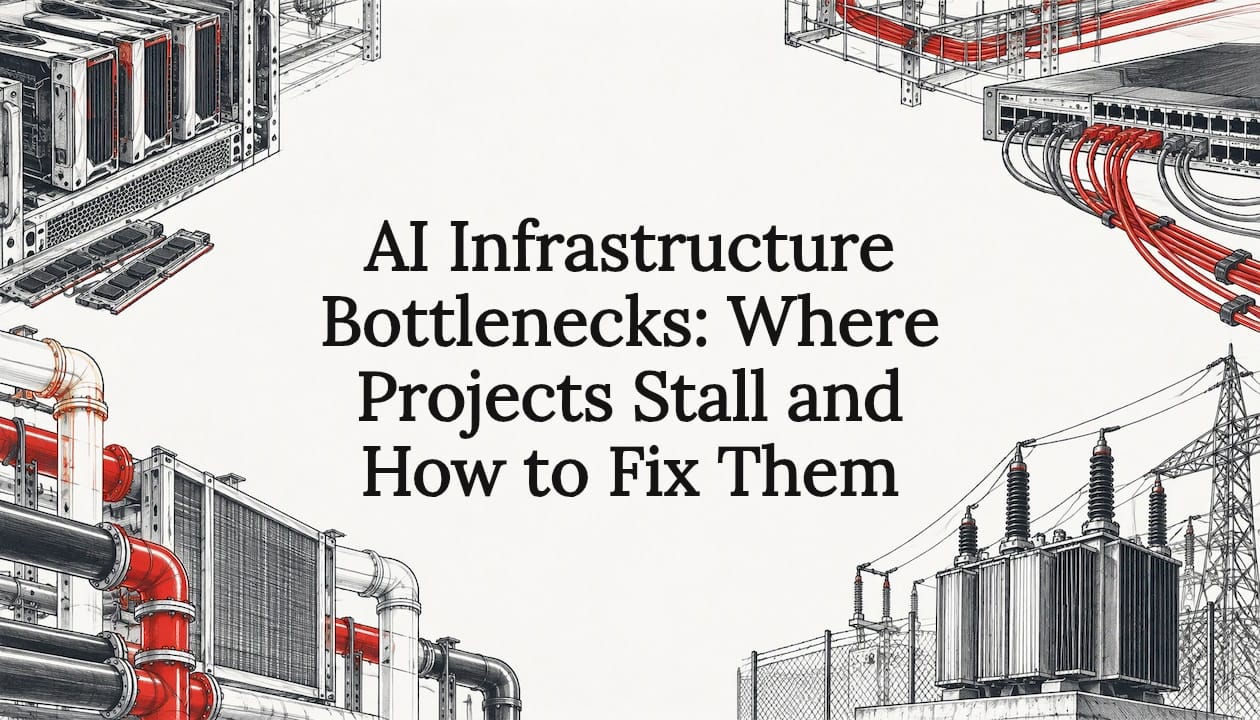
The biggest bottleneck in AI infrastructure is rarely the GPU itself. Projects stall on memory bandwidth, network fabric, power and cooling, grid connections and delivery, and these limits interact. Fixing one often exposes the next. The practical answer is to measure where your accelerators wait, then address the constraint that is actually binding, in the order your project can absorb.
TL;DR
- Compute is only one limit. Memory, interconnects, electricity, cooling and project delivery now gate many AI builds, and they compound each other.
- In a survey by VentureBeat, 57% of respondents running GPUs said the chips sit idle at least half the time, which points to data movement and utilization, not raw chip count.
- Power is the hardest constraint to schedule around: grid connection queues can run longer than the build itself.
- Diagnose before you buy. Measure utilization, trace where jobs wait, and check site power and cooling before ordering more accelerators.
- Treat design, sourcing, siting and logistics as one program. That is how bottlenecks get found early instead of after hardware lands.
Table of Contents
- The main bottlenecks, in one view
- Memory and data movement: why fast chips wait
- Networking: the cluster is the computer
- Power and grid connections: the constraint with the longest lead time
- Cooling and water: density has a ceiling
- Delivery: the bottleneck between a plan and a running cluster
- Money is the brake more often than chips
- How to find your bottleneck
- Ways to reduce each bottleneck
- Why the answer differs by country
- Where Dormedia fits
- Our perspective
- FAQ
- Sources
The main bottlenecks, in one view
The OECD groups the technical limits into three: memory, interconnection, and electricity and cooling. Its Digital Economy Outlook 2026 notes that accelerator performance has tripled every two years while DRAM has scaled only 1.6x, that slow interconnects reduce throughput and lengthen training, and that per-chip power keeps climbing: roughly 400 W for an NVIDIA A100, against a projected 3,000 W for the R300 expected in 2028.
The World Economic Forum's April 2026 analysis of the AI hardware buildout adds the point that matters most for planning: these constraints do not exist in isolation. A facility can have enough power but too little cooling, or enough cooling but a network fabric that cannot connect the GPU clusters efficiently.
| Bottleneck | What it looks like | Where it shows up first |
|---|---|---|
| Memory bandwidth | Accelerators wait on data, especially during inference decoding | Low utilization despite high-end chips |
| Network fabric | Training slows as cluster size grows | Job scaling that flattens past a node count |
| Storage and data pipeline | GPUs idle between batches | Input stalls, long data staging times |
| Power and grid connection | Capacity cannot be energized on schedule | Site selection, utility queues |
| Cooling | Density capped below what the racks could draw | Rack limits, throttling |
| Delivery and logistics | Hardware, parts or approvals arrive out of sequence | Idle sites, rework, cost overruns |
The rest of this article takes each in turn, then shows how to tell which one is yours.
Memory and data movement: why fast chips wait
Accelerator math has outrun the memory that feeds it. McKinsey's October 2026 piece on scaling AI inference describes performance as shaped by three interdependent elements: logic, memory and networking. It expects memory bandwidth and networking to become increasingly important constraints, and says power delivery and thermal management are increasingly gating density before compute does.
The same analysis points to a mismatch many teams live with. Much of the installed base was designed for training and is now serving inference. Training rewards raw compute, while the decode phase of inference rewards memory bandwidth. A cluster that looked well balanced for training can leave expensive silicon waiting once it serves models.

The symptom is easy to recognize: high-end GPUs, modest utilization. VentureBeat's VB Pulse AI Infrastructure and Compute Report found that 57% of respondents running GPUs said those chips sit idle at least half the time, and another 33% of those organizations do not measure utilization at all. You cannot fix what you do not measure.
What to check
- Memory capacity and bandwidth per accelerator against your model sizes and batch patterns.
- Whether your workload is training-heavy, inference-heavy or mixed, and whether the hardware was specified for that mix.
- Storage throughput and the data path from storage to GPU memory.
Networking: the cluster is the computer
AI clusters are no longer small islands of compute. Traditional enterprise networks were designed around north-south traffic between users and servers, while AI training generates heavy east-west traffic between accelerators. Collective operations make every GPU wait on the slowest link, so a weak spot in the fabric slows the whole job.
McKinsey's inference article goes as far as saying the network is becoming part of the computer itself. In practice that means topology, oversubscription ratios, switch selection, cabling and congestion control belong in the first design review, not in a late procurement line. Our guides on how to design the AI networking fabric and on high-speed interconnects for HPC and AI go into the design choices in detail.
The IEA's Energy and AI report is a useful reminder that networking and storage also draw power: networking equipment accounts for up to 5% of data center electricity demand, and storage around 5%. They are small slices of the load, but they sit in the same power and cooling envelope as everything else.
Power and grid connections: the constraint with the longest lead time
For many new sites, electricity is the first thing that cannot be rushed. The IEA's Powering Artificial Intelligence executive summary says the AI investment boom is straining local grids and stretching supply chains for key electrical equipment. In several jurisdictions, it reports, network planners see data center connection queues with cumulative capacity larger than today's peak demand.
A few figures show the scale:
- Globally, one in five planned data center projects is at risk of delay because of power constraints, and new transmission lines can take four to eight years in some APEC economies, according to an FTI report on the data center dilemma.
- Goldman Sachs Research projects data center power demand to rise 165% by 2030, requiring an estimated $720 billion in grid upgrades, as cited in the World Economic Forum article.
- In Europe, a Slaughter and May regulatory guide finds power access is the single greatest constraint on data center development in every jurisdiction it surveyed, and that first-come-first-served connection allocation is giving way to systems that prioritize project readiness, financial commitment and policy alignment.
That last point changes how you prepare. Where connection capacity is allocated on maturity, a project with a clear design, a funded plan and a defined load profile ranks ahead of one with a vague wish for megawatts. The guide also observes that latency-tolerant AI workloads have loosened the need to sit near end users, so developers can follow available power to more remote sites, and that early engagement with the network operator is a crucial step in site identification.
This is why site selection and electrical planning belong at the start of an AI build. Our practical guide to data center site selection for HPC and AI covers the criteria, and the later installment on siting goes deeper on the trade-offs.
Cooling and water: density has a ceiling
Every watt delivered to a rack becomes heat that has to leave the building. The IEA reports that cooling takes about 7% of total electricity in efficient hyperscale facilities but over 30% in less efficient enterprise data centers. That gap is the difference between a site that can host dense AI racks and one that cannot, without a retrofit.
Liquid cooling is the standard answer as densities rise. The World Economic Forum article reports the data center liquid cooling market reached $6.65 billion in 2025 and is growing at over 20% annually. Moving to liquid affects the whole facility: piping, heat rejection, floor loading, maintenance routines and the skills of the operating team.
Water is the second half of the story. The OECD notes that data centers are already among the top-10 water-consuming industries in the United States, and that many cluster in areas with scarce water supplies, particularly in the western United States, in its analysis of AI infrastructure competition. EcoEngineers, in a report on the coming power crunch, puts average water use at 1.8 to 1.9 liters per kilowatt-hour of electricity consumed. Water availability is therefore a siting criterion alongside power, and teams weighing it can look at how siting, energy and operations can be coordinated as part of a broader AI plan.
For how resilience, redundancy and thermal design hold up under AI loads, see our data center resilience guide.
Delivery: the bottleneck between a plan and a running cluster
A design that works on paper still has to be sourced, shipped, cleared, installed and commissioned, in a sequence that matches the site's readiness. Delays here are usually not one dramatic failure. They are small mismatches: servers that arrive before the room is energized, components that do not match the validated configuration, or customs paperwork that holds a pallet for weeks.
The Wharton and Foresight pieces that rank for this topic make the same broad point: lead times and the slowest supplier set the real pace of scaling. We would add the practical consequence. Treat each long-lead item, whether electrical gear, cooling equipment, accelerators or optics, as its own track with its own date, and plan the build around the longest one rather than the most exciting one.
For global deployments, add cross-border realities: duties, tax treatment, import documentation and local installation capacity. These vary by country and are cheaper to plan at the start than to correct after goods are in transit.
Money is the brake more often than chips
It is tempting to assume the shortage is compute. The VB Pulse report suggests otherwise: 38% of respondents said their organization delayed, scaled back or canceled a planned AI project in the past 12 months because it cost more than planned, while 12% cited a shortage of computing capacity. Cost overruns, not chip scarcity, were the more common brake.
That result fits the technical picture. When utilization is low, power is under-provisioned or the network cannot feed the accelerators, you pay full price for capacity you cannot fully use. Fixing balance often delivers more than buying more.
How to find your bottleneck
Work from the workload outward. A simple sequence:
- Measure utilization. Track GPU utilization and memory use over time, per job. If you are not measuring, start there.
- Trace the waits. Profile a representative training or inference job. Is time spent in compute, in collective communication, or waiting on input data?
- Test scaling. Run the same job at two or three cluster sizes. If throughput per GPU drops sharply as you add nodes, suspect the fabric.
- Check the physical envelope. Compare rack power and cooling capacity to what the accelerators will draw at full load, including the next hardware generation you expect to adopt.
- Check the site and grid. Confirm contracted capacity, the timeline for any additional connection, and the water and cooling plan.
- Map the delivery chain. List every long-lead item with its supplier, route, duties and install dependencies.
Write the result as a ranked list. The first item is the one that caps your throughput or schedule today. The second is the one you will hit as soon as the first is fixed.
Ways to reduce each bottleneck
The Dalberg Playbook for Advancing Resilient AI Infrastructure argues that coordinated choices across the AI stack (use cases, model design, siting and operations), energy systems and grid integration lead to meaningful reductions in energy, water and emissions, and that the largest benefits come when solutions reinforce each other. The same logic applies to bottlenecks.
| Bottleneck | Levers that usually help |
|---|---|
| Memory | Match accelerator memory to model and batch profile; separate training and inference pools where the workloads differ |
| Network | Design topology and oversubscription for your collective patterns; validate optics and cabling before scale-out |
| Data pipeline | Stage data close to compute; size storage throughput to the GPU count |
| Power | Engage the utility early; define a phased load profile; consider sites where capacity is confirmed |
| Cooling | Plan liquid cooling from the start for dense racks; size heat rejection for the next generation |
| Delivery | Sequence orders to site readiness; consolidate logistics; resolve tax and tariff treatment before shipment |
A note on organizational readiness: some bottlenecks are not physical. Teams that have not yet decided which operational problems AI should solve will struggle to size infrastructure at all. A clear view of where to start with AI in operations helps tie hardware decisions to real workloads.
Why the answer differs by country
The Dalberg Playbook notes that countries will follow different paths, shaped by national priorities, AI ambitions and resources, including access to clean and reliable energy, investment capital, land, water systems and institutional capacity. It identifies two interlinked constraints on resilient growth: limited clean and reliable energy, and a mismatch between data center siting and local resource availability. It also notes that data center expansion is moving faster than clean energy infrastructure.
For a company deploying in several regions, that means one design rarely transfers cleanly. Connection rules, power pricing, climate and import regimes all differ. A global program needs a standard reference design with local adaptations, not identical sites.
Where Dormedia fits
We are a consultancy for HPC and AI infrastructure. We have worked in the field since 2011 and deeply in HPC and AI since 2017, and we help organizations design, source, deploy and scale the technology they need, working with a network of vendors and logistics specialists.
If your project is stuck between design and delivery, our engagements cover the full chain: customized server and component configurations, data center solutions, global shipping, tax and tariff solutions, project management, strategic advisory and ongoing support.

To discuss a build, start at dormedia.ai, or browse what is on hand in our available hardware inventory.
Our perspective
We see the same pattern across HPC and AI projects: the hardware list is rarely what fails. The sequence fails. Accelerators are specified before the network is designed, racks are ordered before cooling is confirmed, and shipments leave before duties and installation windows are settled.
Our view is that bottlenecks are cheapest to remove on paper. That is why we start with the workload, then design the compute, memory, fabric, power and cooling together, and only then source. Sourcing through a broad vendor and logistics network lets us align delivery dates with site readiness instead of treating them as separate problems.
For organizations deploying across borders, we add tax and tariff planning and global shipping to the same program, so one team owns the path from first design review to a running cluster, and stays on afterward through ongoing support and strategic advisory. Our approach is built around customized configurations rather than a fixed catalog, because the right balance of memory, network and power depends on what you run.
Dormedia
FAQ
What is the biggest bottleneck in AI infrastructure today?
There is no single one. Memory bandwidth, network fabric, power, cooling and delivery all constrain real projects, and they interact. For new data center builds, power and grid connection often have the longest lead times. For existing clusters, low utilization usually points to memory, network or data pipeline limits.
Is the GPU shortage still the main problem?
Not for most organizations surveyed. In the VB Pulse report, 38% of respondents delayed or canceled a project because of cost, while 12% cited a shortage of compute capacity. Balance and utilization often matter more than the raw number of accelerators.
How do I know whether my network is limiting training?
Run the same job at several cluster sizes and watch throughput per GPU. If it falls sharply as you add nodes, or profiling shows long waits in collective communication, the fabric is a likely cause. Our AI networking design guide explains the design factors.
Why does power limit where AI data centers get built?
Grid connections and electrical equipment take years in many markets, and the IEA reports connection queues in several jurisdictions larger than today's peak demand. Sites with confirmed capacity are increasingly valuable, so power access shapes location before almost anything else.
Can one partner handle design, sourcing and shipping together?
Yes. We run these as one program for clients: design, sourcing, deployment, global logistics, tax and tariff compliance and ongoing support, so dependencies are visible from the start.
Sources
- OECD Digital Economy Outlook 2026: Powering AI progress
- World Economic Forum: the $7 trillion AI hardware buildout
- McKinsey: The cost of intelligence, how to scale AI inference
- VentureBeat: VB Pulse AI Infrastructure and Compute Report
- IEA: Energy demand from AI
- IEA: Powering Artificial Intelligence, executive summary
- FTI: Powering the Digital Economy, the Data Center Dilemma
- Slaughter and May: Power and Place
- OECD: Competition in artificial intelligence infrastructure
- EcoEngineers: The Coming Power Crunch
- Dalberg: Playbook for Advancing Resilient AI Infrastructure